
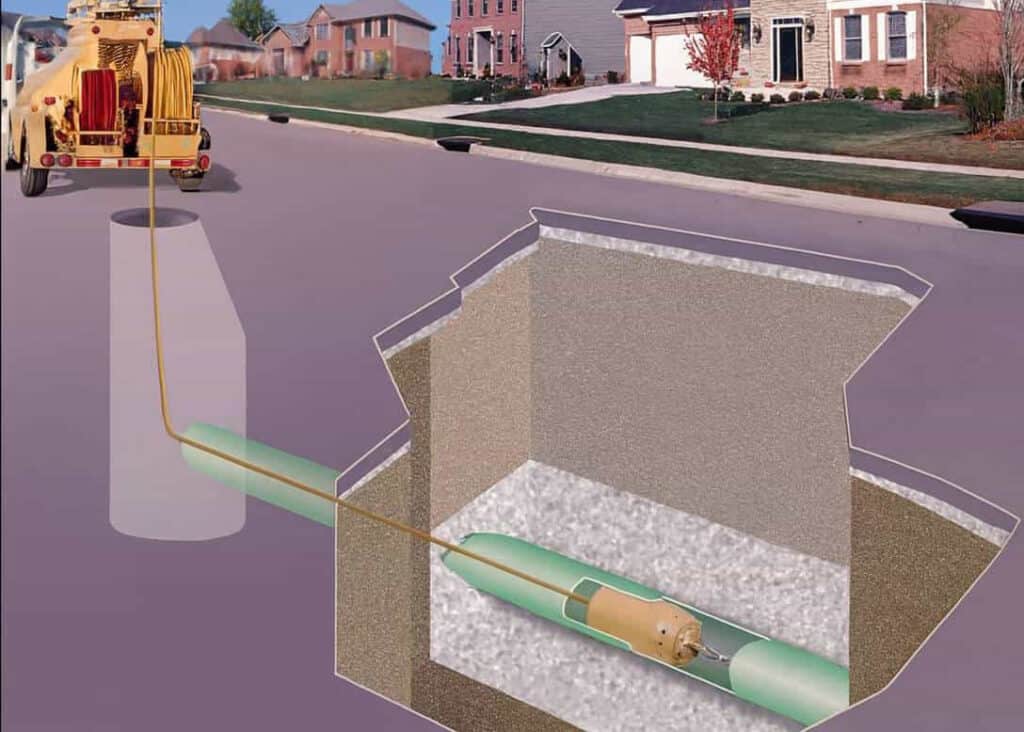
When pipe deflection occurs, it is easy to assume the repair must happen from the outside. Dig down, expose the pipe, rework the bedding, and start over.
The Williams Excavating℠ Rerounder™ System takes a very different approach.
Instead of disturbing what is above the pipe, the system works from inside the pipe to correct the real issue beneath and around it. The process is controlled, predictable, and based on field-tested engineering principles that address both pipe shape and soil support at the same time.
Step One: Identifying What Actually Needs to Be Fixed
Deflection is not just a pipe shape problem. It is a soil support problem.
Flexible pipe depends on uniform, properly compacted bedding and backfill to distribute load evenly. When that support is uneven or incomplete, the pipe deforms. Restoring the pipe without restoring the soil would only create a temporary result.
That is why the Williams Excavating℠ Rerounder™ System is designed to correct both conditions simultaneously.
Step Two: Introducing Controlled Internal Vibration
The Williams Excavating℠ Rerounder™ System uses a pneumatic vibration unit that is pulled through the interior of the pipe. The unit is sized and balanced specifically for the pipe diameter being addressed.
When powered by compressed air, the system generates controlled vibration at a frequency designed to mobilize granular bedding material without damaging the pipe.
This vibration is intentional and calibrated to work in harmony with flexible pipe systems.
Step Three: Transmitting Energy Through the Pipe Wall
As the Williams Excavating℠ Rerounder™ System moves through the pipe, vibration energy travels outward through the pipe wall and into the surrounding bedding and backfill.
This internal transmission of energy is a key distinction from surface or external compaction methods.
External equipment often cannot effectively reach the trench cradle or haunching zones where support matters most. Internal vibration reaches these critical areas directly because the pipe itself becomes the transmission path.
Step Four: Compacting the Bedding Where Support Is Required
The applied vibration causes soil particles in the pipe zone to rearrange and settle into a denser, more stable configuration.
Voids collapse. Loose material tightens. Load paths become more uniform.
Soil density increases in the areas that directly support the pipe, including beneath and alongside it. Once bedding is compacted evenly, it can carry structural load as intended.
Step Five: Restoring the Pipe to Its Original Shape
As soil support improves, pressure around the pipe becomes balanced.
With uniform support restored, the pipe naturally returns toward its original round shape. In most applications, deflection is reduced to within allowable limits as the Williams Excavating℠ Rerounder™ System passes through the pipe.
The pipe is not being forced into shape. It is responding to corrected support conditions.
Step Six: Locking in Long-Term Performance
One of the most important outcomes of rerounding is what happens after the process is complete.
By achieving proper compaction throughout the pipe zone, future settlement and creep are minimized. The soil has already consolidated under load, leaving far less opportunity for continued movement.
This is why rerounding is considered a permanent correction rather than a temporary adjustment.
Step Seven: Immediate Verification
Once rerounding is complete, mandrel or deflection testing can typically be performed immediately.
There is no waiting period, no curing time, and no need to disturb the site. Results are measurable, verifiable, and repeatable.
Why the Williams Excavating℠ Rerounder™ System Works
This process succeeds because it addresses cause and effect at the same time.
- It restores pipe shape by restoring soil support.
- It compacts bedding without excavation.
- It corrects deflection without replacing pipe.
Rather than treating deflection as a failure, the system treats it as a correctable condition within a flexible pipe installation.

A Smarter Way to Solve Deflection Problems
For contractors, rerounding reduces delays and eliminates unnecessary rework.
For engineers, it provides a defensible solution supported by real-world performance.
For owners and municipalities, it delivers long-term reliability without unnecessary disruption.
Understanding how the Williams Excavating℠ Rerounder™ System works makes one thing clear.
You do not need to dig to fix deflection.
You need to correct the support system that caused it.